NURSERY AND PLANTS · US · RAINTREENURSERY.COM
Raintree Nursery: Pre-order app with seasonal limits
Raintree Nursery sells fruit trees and other plants across the US, and takes pre-orders for a planting season. The pre-order apps it had tried could not cap a plant at what the nursery can really grow, limit sales to a date window, or send notifications under heavy traffic, so we built a custom Shopify app that does all three.
IN SHORT
- Raintree Nursery sells fruit trees and other plants across the US, and takes pre-orders for a planting season.
- The pre-order apps it had tried could not cap a plant at what the nursery can actually grow, and could not limit sales to a window of dates.
- They also failed to send notifications reliably at the nursery's traffic, so we built a custom Shopify app with a limit and a window for every product and automatic emails.
- Shipping the pre-orders when the season comes is a second app, described in its own case study.
The challenge
A nursery sells on the calendar, and what it can sell is fixed by what it can grow. Its planting area is limited, and not every plant that is started makes it: if 150 are planted and about 100 are expected to come through, the nursery can safely promise 100 and no more. Pre-orders therefore need a hard limit for each product, and they have to open and close on set dates, because a plant can only be promised for its own season.
The pre-order apps the nursery had tried did not fit. They had no way to enforce the nursery's own limit and window, and their notifications did not go out. The nursery gets heavy traffic, and those apps send a notification when a product is out of stock. A pre-order that has reached its limit is a different case from a product that is out of stock, so they did not handle it.
- Client
- Raintree Nursery (raintreenursery.com)
- Industry
- Nursery and plants
- Market
- US
- Platform
- Shopify, with a custom app
- Mailgun
- Also delivered
- A shipping app, covered in its own case study
How we approached it
- 01
Learn the nursery's limits
We worked out the rules the nursery already follows: which plants are pre-ordered, how many of each it can promise from its fixed growing area, and when each pre-order should open and close.
- 02
Put a limit on every product
The app lists the nursery's products from Shopify and lets the team set a pre-order limit for each, so the nursery never takes more pre-orders than it can fill.
- 03
Add a date window
Each product has a start date and an end date, and pre-orders can only be taken between them.
- 04
Load each season from a file
At the start of a season the team uploads the data and imports it from a CSV file, so a new season is loaded in one step instead of product by product.
- 05
Notify customers automatically
When a customer has asked to be told about a plant, the app sends the email itself, from templates we set up. Emails go out through Mailgun, and the sender and settings are configured in the app.
- 06
Show how the season is going
For every product the app shows how many pre-orders have come in against the limit, the year, and whether the limit is met, so the team sees at a glance what is sold out.
A limit and a window for every plant
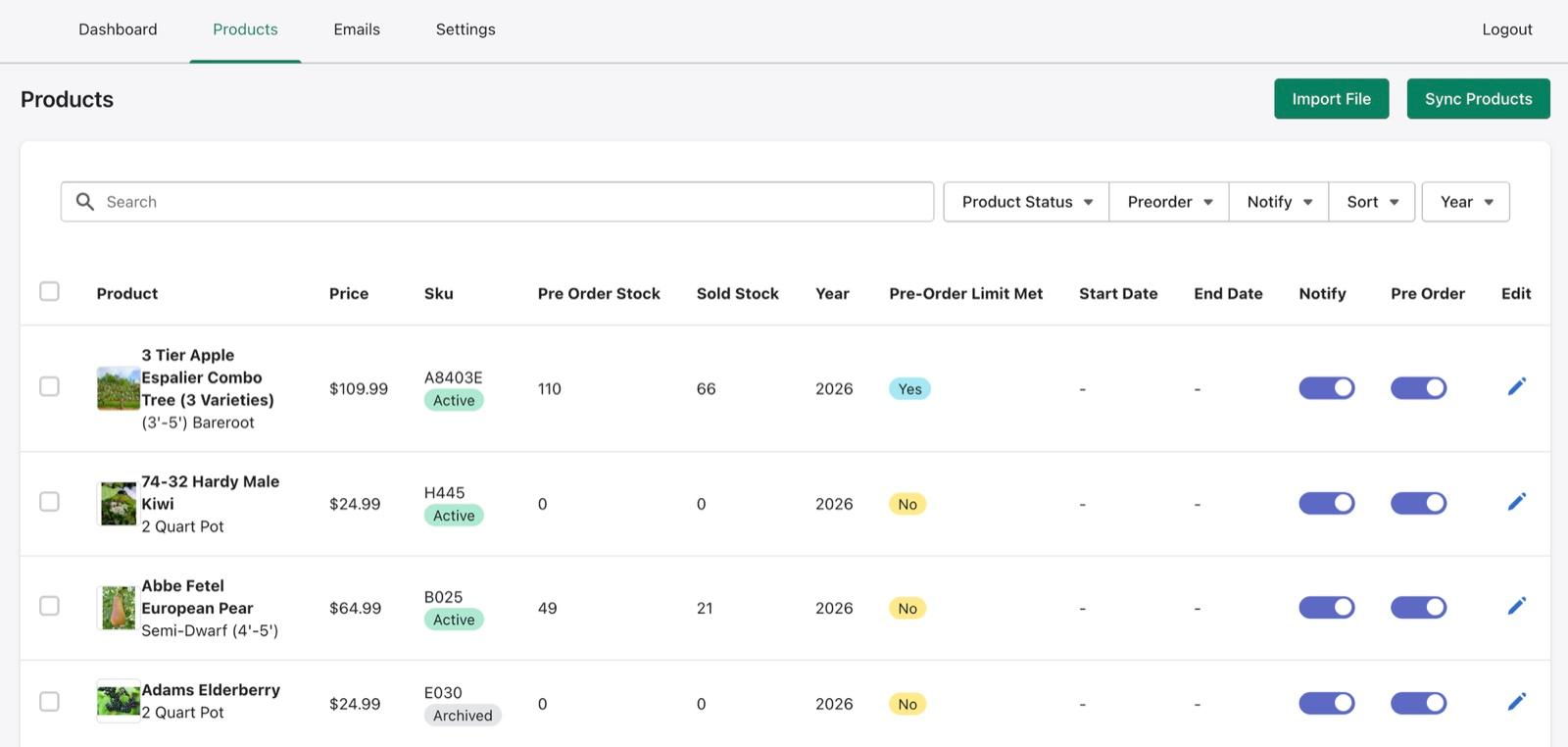
The Products screen of the pre-order app is where the nursery runs its season. Each row is a plant, such as a three-tier apple espalier combo tree or a pear, with its price and SKU, the pre-order stock, the stock sold so far, the year and the start and end dates of its pre-order window.
A column shows when the limit has been met. A switch turns pre-order on or off for each product, and another turns on notification for customers who want to know when a plant is available. The notification emails are sent by the app from templates, not by hand.
The two rules the nursery cared about most are here in one place: how many it can take, and between which dates. Because they live in the app, the team does not have to track them by hand.
The result
The nursery now sets a limit and a date window for every plant in one app, loads each season from a file, and emails customers automatically, where the apps it tried had none of these. Pre-orders, limits and customer notifications are now easy to manage in one place.
Because the app is built for a seasonal calendar, the same set-up serves each year's pre-order season, with the year shown on every product row.
- Custom app that sets a limit and a window for every plant
- 1
- Pre-order season, run from the app
- Sep-Nov
Questions about the Raintree Nursery migration
What did Lucent Commerce build for Raintree Nursery?
A custom Shopify pre-order app with a limit and a start and end date for every plant, CSV import, and automatic emails, plus a second app for shipping, described in its own case study.
Why was a custom app needed?
The pre-order apps the nursery had tried could not cap each plant at what it can grow or limit pre-orders to a window of dates, and their notifications did not go out reliably at the nursery's traffic.
Why does each plant have a limit?
The nursery's growing area is fixed and not every plant started comes through, so it can only promise what it expects to have. If 150 are planted and about 100 are expected, the limit is 100.
How is a new season loaded?
The team uploads the season's data and imports it from a CSV file.
How are customers notified?
The app sends the emails itself from templates, through Mailgun.
When is the pre-order season?
It runs from late September to early November, and the plants are shipped across the US when the planting season comes.
What results did Raintree Nursery see?
The nursery sets a limit and a date window for every plant in one app, loads each season from a file and emails customers automatically, which the apps it tried could not do. The same set-up serves every year's pre-order season.