MULTI-VENDOR MARKETPLACE · MALAYSIA · EATCAKETODAY.COM
Eat Cake Today: Multi-vendor cake delivery
Eat Cake Today is a funded Malaysian startup that sells cakes from many local bakers and kitchens and delivers them the same day. We built the Shopify storefront and the back end behind it: each vendor's capacity and each cake's making time decide which dates and times a shopper is offered, and each order goes straight to the kitchen and a rider. The service now covers three to four cities.

IN SHORT
- Eat Cake Today is a funded Malaysian startup that sells cakes from many local vendors and delivers them the same day.
- We built its Shopify storefront and a custom back end that tracks every vendor's capacity and every cake's making time.
- A shopper only sees delivery dates and times a vendor can meet, and the order is checked again at checkout before it is accepted.
- Placed orders go to the kitchen and to a rider automatically, and the service now covers three to four cities in Malaysia.
The challenge
Eat Cake Today wanted to put the local cake trade online: many bakers, cloud kitchens and small shops, one storefront, and delivery the same day. A startup with funding behind it, it needed the whole system built from nothing, not a template shop.
The hard part is that a cake is not a stock item. A vendor can only make so many of each kind of cake in a day, each cake takes a different time to make, and a kitchen has a limited number of people and hours. If the store shows a delivery date nobody can meet, the cake is late or the order is cancelled. The store had to know, for every cake and every vendor, what could really be made and delivered.
- Client
- Eat Cake Today (eatcaketoday.com)
- Industry
- Cake delivery marketplace
- Platform
- Shopify
- Market
- Malaysia
- Also delivered
- Multi-vendor back end, rider connection, review and other integrations
- Result
- Same-day delivery in three to four cities
How we approached it
- 01
Model how a cake gets made
We worked out what limits a vendor: how long each cake takes to make, how many of each kind they can make in a day, and how many cakes a kitchen can run at once in the hours it has.
- 02
Let vendors set their own capacity
Each vendor, whether a cloud kitchen, a cake company or a small shop, gives us the number of each cake they can make per day. Those allocations and each cake's making time feed the back end.
- 03
Build the Shopify storefront
We built the storefront on Shopify, with cakes from every vendor in one catalog, so a shopper browses cakes and not vendors.
- 04
Offer only what can be delivered
When a shopper picks a cake and a date, the back end checks which vendors can make it, using their capacity and current orders. Then the shopper picks a delivery time, and only times that fit the making time are offered.
- 05
Check again at checkout
The shopper adds a card message and a contact number. At checkout the date and time are checked with the back end a second time, so an order is accepted only if it is still feasible.
- 06
Send the order on, then launch
A placed order reaches our back end, which messages the kitchen to start preparing and tells a rider when to collect and deliver. We connected the vendors, the riders and the storefront, added review and other integrations, and launched the brand.
Pick a date, see what can actually be delivered
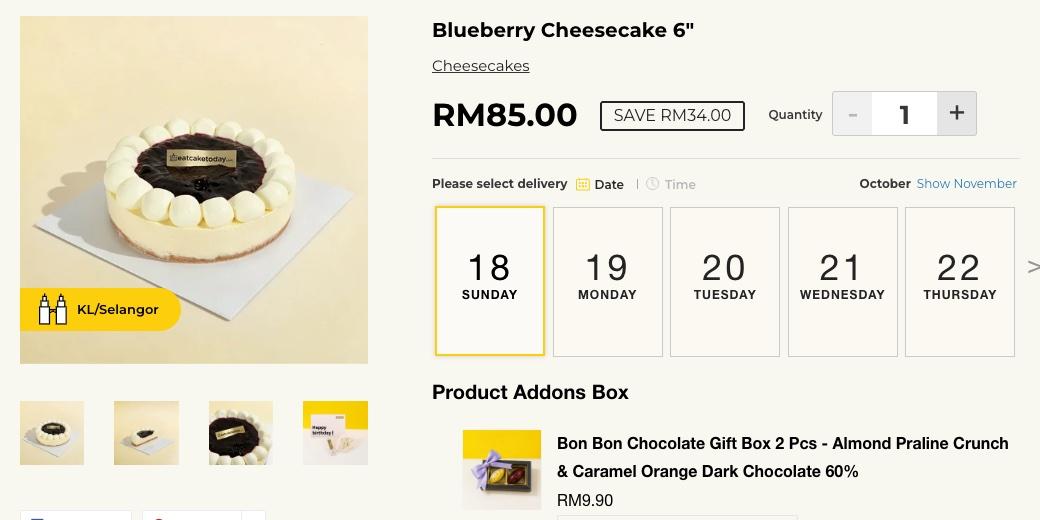
On a cake page the shopper picks a delivery date and then a time. Those choices are not a fixed calendar. The back end builds them for that cake: it looks at the vendors who make it, their capacity for the day and the orders they already have, and shows only what one of them can do.
The making time sets the earliest slot. A cake that takes four hours cannot be delivered an hour after an order at ten in the morning, so the first slot offered that day is later. The same data decides which vendors are available, so the shopper never has to think about who bakes the cake.
Because capacity can change between choosing and paying, the same check runs again when the shopper goes to checkout. After payment the order is passed to the vendor's kitchen and to a rider, so nobody rekeys it by hand.
The result
The system worked for the client in Malaysia, and Eat Cake Today now serves three to four cities. That is the owner's account of the project; no revenue or order figure is stated.
Because vendors set their own capacity and the back end does the checking, a new vendor or a new city is added by loading its cakes and allocations, not by rebuilding the store.
- Cities in Malaysia served
- 3-4
- Delivery for cakes ordered in time
- Same day
Questions about the Eat Cake Today migration
What did Lucent Commerce build for Eat Cake Today?
A Shopify storefront and a custom multi-vendor back end that tracks vendor capacity and cake making times, checks delivery feasibility, and sends orders to kitchens and riders.
How does the store know which delivery dates to show?
The back end checks which vendors can make the chosen cake, using each vendor's daily capacity, the cake's making time and the orders they already have, and offers only dates and times that fit.
What happens if capacity runs out before checkout?
The date and time are checked with the back end again at checkout, so the order is accepted only if it is still feasible.
How does an order reach the kitchen and the rider?
A placed order enters the back end, which automatically messages the vendor's kitchen to start preparing and tells a rider when to pick up and deliver.
Which kinds of vendors does the marketplace connect?
Cake companies, cloud kitchens and small shops, each of which sets how many of each cake it can make in a day.
Where does Eat Cake Today deliver?
It now serves three to four cities in Malaysia.